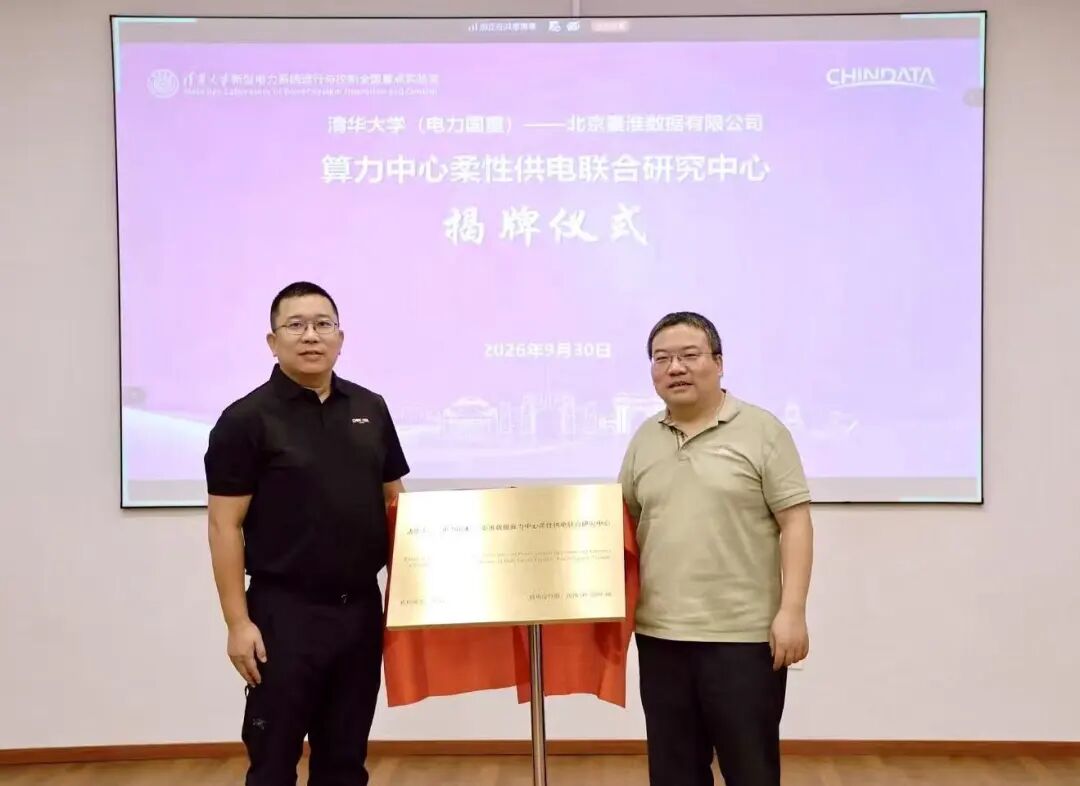
On September 30, Chindata and Tsinghua University officially inaugurated the Tsinghua University–Chindata Joint Research Center for Flexible Power Supply to Data Centers at Tsinghua University. Responding to the parallel demands of developing a new power system and supporting the high-quality growth of the computing industry, the two parties will work together on key flexible power technologies to develop next-generation power solutions for AI infrastructure that are safe, reliable, cost-effective and low-carbon. Their collaboration will also focus on developing a grid-friendly AI data center (AIDC) demonstration project and advancing industry standards for flexible power supply, helping enable more effective coordination between computing infrastructure and power systems.
The unveiling ceremony was attended by Professor Yingduo Han, Member of the Chinese Academy of Engineering; Researcher Fei Xu, Deputy Director of Tsinghua University's State Key Laboratory of Power System Operation and Control and Chair of the Joint Research Center's Steering Committee; Professor Zedong Zheng, Secretary of the CPC Committee of the Department of Electrical Engineering at Tsinghua University; and Professor Chao Lu, Deputy Head of the Department of Electrical Engineering. Chindata was represented by CEO Wu Huapeng, CTO Xue Guoqing, COO Li Mingjiang and Senior Vice President Chen Shengjun.
Addressing the Power Challenges of the AI Era
The Joint Research Center is supported by Tsinghua University's State Key Laboratory of Power System Operation and Control, one of the first 20 national key laboratories approved by China's Ministry of Science and Technology. The laboratory plays an important role in advancing cutting-edge technologies for new power systems and supporting the country's broader energy strategy.
As AI computing continues to expand rapidly and renewable energy takes on a growing role in the electricity supply mix, closer coordination between data centers and power systems is becoming increasingly important. Several challenges need to be addressed.
Aligning power supply with computing demand. The rapid expansion of computing capacity is placing increasing pressure on grid resources, while the long lead times for grid construction often make it difficult to match power infrastructure development with data center deployment schedules.
Integrating and utilizing renewable energy. Renewable electricity often needs to be aggregated across multiple locations and connected to the grid in different regions. This places additional pressure on transmission capacity and can increase the volume of power fed back into the grid, making it more difficult for data centers to increase direct consumption of renewable electricity.
Managing interactions between the grid and workloads. Wideband oscillations, disturbance ride-through requirements and sudden load fluctuations can introduce new risks to grid stability and affect the reliable operation of the power system.
Improving overall efficiency and economics. Traditional power architectures rely on extensive redundancy and substantial capital investment to ensure reliability, resulting in high construction and energy costs. Conventional backup diesel generators add further challenges, including significant space requirements, assets that remain underutilized for extended periods, and the complexity of fuel supply, environmental compliance and maintenance.
Flexible power supply is central to addressing these challenges. By accommodating multiple energy sources, supporting different output voltage levels and coordinating energy storage across multiple tiers, a flexible power system can serve as an intelligent hub connecting electricity supply with computing demand. This enables data centers not only to secure reliable power but also to actively support grid operations.
Drawing on Tsinghua University's research expertise in power systems and Chindata's extensive industry experience and gigawatt-scale engineering capabilities, the Joint Research Center will focus on major technical challenges, including new power supply architectures, coordinated control and protection of multiple power converters, and grid-connected stability analysis and control. The work will establish a theoretical, technological and practical foundation for next-generation flexible power solutions for data centers.
Advancing Flexible Power Technologies Through Industry-Academia Collaboration
Wu Huapeng, CEO of Chindata, said: “The rapid development of AI is driving a fundamental transformation of the data center industry, with power infrastructure emerging as a critical bottleneck. Establishing this Joint Research Center with my alma mater is an important step toward tackling the industry's most pressing challenges.
“Chindata will commit the resources needed to work with Tsinghua University on core flexible power technologies, enabling grid electricity, renewable energy and energy storage to move beyond operating as separate resources toward a more coordinated, multi-source system. We aim to help AIDCs progress from adapting to the grid, to supporting the grid, and ultimately to actively establishing and stabilizing grid conditions through grid-forming capabilities. Through this collaboration, we will develop integrated, practical and efficient solutions to advance coordination between computing and power.”
Researcher Fei Xu said: “As AI advances rapidly, data centers face increasing demands in power reliability, renewable energy utilization and operating economics. We hope the Joint Research Center will serve as a platform for combining Tsinghua University's research strengths in power systems with Chindata's industry expertise and practical experience. By closely aligning frontier research with real-world engineering needs, we can advance key technologies and accelerate the translation of research into practical applications, supporting both the development of the computing industry and the evolution of the new power system.”
From Technology Development to Industry Standards
Over the next three years, the Joint Research Center will leverage the strengths of collaboration between academia and industry to advance innovation across the full development cycle, from technology research and engineering demonstrations to industry standards.
The two parties plan to develop a demonstration project in Ulanqab and establish a rapid-response platform for coordinating data center operations with the power grid across Chindata's Capital Region cluster. The center will also turn practical experience into replicable approaches and industry standards, helping accelerate the scaled deployment and commercialization of flexible power technologies.
Through this collaboration, Chindata and Tsinghua University aim to advance the integration of computing infrastructure and power systems, opening new pathways for the deeper integration of China's computing industry with its evolving power system.


 京公网安备11010502041643号 京ICP备17015547号-2
媒体与品宣 请联系 media@chindatagroup.com
投资者关系 请联系 ir@chindatagroup.com
招聘与HR 请联系 hrenquiry@chindatagroup.com
业务与合作 请联系 bd@chindatagroup.com
中国总部地址:
北京市朝阳区来广营西路望京诚盈中心8号楼 邮编:100012